datasheet2spice
Traceable datasheet-to-SPICE model generation for power MOSFETs and diodes, with validation benchmarks.
Architecture
datasheet2spice is being shaped as a general datasheet-to-model toolkit. The
first production component family is power MOSFET / SiC MOSFET, but the
architecture is intentionally split so later component packs can add IGBTs,
BJTs, op amps, regulators, magnetics, and small engineering tools.
Layering
Web UI / CLI / future desktop shell
        |
        v
API contract and backend adapters
        |
        v
service layer
        |
        v
core schema, units, provenance, runtime capabilities
        |
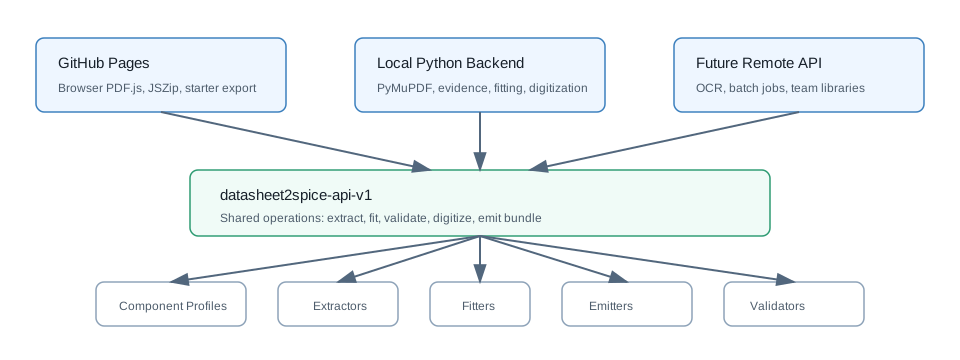
        +--> component profiles
        +--> extractors
        +--> fitters
        +--> model emitters
        +--> validators
        +--> tool panels
The HTTP workbench is deliberately thin. It parses requests, stores uploads,
and calls datasheet2spice.service. This keeps extraction, fitting, model
generation, and reporting reusable from a local REST server, CLI commands,
tests, and future desktop or remote adapters.
Runtime Modes
The frontend should target one stable contract and then select an adapter:
browser-pages: static GitHub Pages, PDF.js, JavaScript, Web Workers, and future Rust/WASM helpers. This mode is no-install and should demonstrate the product well, but it avoids simulator execution and heavy server-side OCR.local-python: high-fidelity local backend with PyMuPDF extraction, screenshot evidence, table candidates, vector/raster curve digitization, fitting, quality scoring, and optional simulator smoke tests.remote-api: future hosted backend for AI/OCR, batch processing, and team model libraries. It is intentionally not required for the v1 workflow.
The runtime capability matrix lives in datasheet2spice.runtime so docs, APIs,
and UI labels can stay consistent.
Data Model Direction
DeviceProject remains the backward-compatible Python class. ComponentProject
is an alias that signals the broader roadmap.
New projects include a component envelope:
{
  "schema_version": "1.0",
  "component": {
    "family": "mosfet",
    "profile": "mosfet.power"
  },
  "device": {
    "part_number": "EXAMPLE",
    "type": "n_power_mosfet"
  }
}
The common envelope should hold identity, provenance, review state, and model targets. Component profiles define the family-specific fields that are required for extraction, fitting, and model emission.
Plugin Boundaries
Built-in and third-party packages can extend these surfaces:
- component profiles,
- PDF/text/table/curve extractors,
- parameter fitters,
- model emitters,
- validators,
- UI tool panels.
The current built-in component profiles are mosfet.power and diode.power.
The current built-in emitters are vdmos-static-fast, abm-basic, and
diode-basic, and diode-abm-dynamic.
Design Rules
- Keep the core schema and emitters dependency-light.
- Put optional PDF, OCR, simulator, and AI dependencies behind service or plugin boundaries.
- Every extracted value should be auditable through provenance and evidence.
- GitHub Pages should remain useful without installation, but the local backend is the authoritative path for high-fidelity extraction and verification.
- Generated models are starters, not vendor-qualified device models.