datasheet2spice
Traceable datasheet-to-SPICE model generation for power MOSFETs and diodes, with validation benchmarks.
Interface Contracts
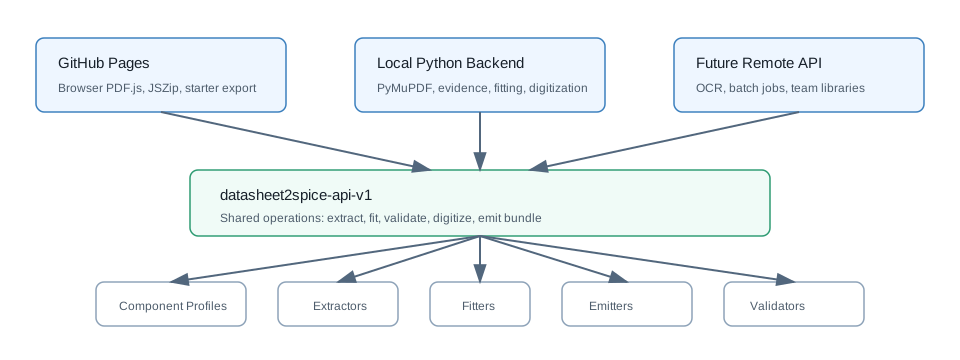
datasheet2spice uses two stable JSON-first contracts:
datasheet2spice-api-v1: operations exposed by browser, local, or future remote backends.datasheet2spice-module-v1: manifests exposed by extractors, model emitters, fitters, validators, component profiles, backend adapters, and tool panels.
The goal is to let new modules join through registration instead of changing the workbench control flow.
Module Manifest
Every module should expose a small manifest:
{
  "contract": "datasheet2spice-module-v1",
  "id": "my-company.power-diode-extractor",
  "kind": "extractor",
  "label": "Power Diode Extractor",
  "version": "0.1.0",
  "description": "Extracts diode ratings and recovery parameters.",
  "component_profiles": ["diode.power"],
  "runtime_modes": ["browser-pages", "local-python"],
  "capabilities": ["extract_pdf_text", "extract_project_from_text"],
  "dependencies": []
}
Module ids should use lowercase letters, numbers, ., _, and -.
Module Kinds
component-profile: declares a device family and its expected fields.extractor: turns PDF text, tables, images, curves, or lab files into project data and evidence.model-emitter: generates SPICE, Verilog-A, reports, or bundle files.fitter: turns reviewed values, curves, or waveforms into model parameters.validator: checks schema, units, physical consistency, and model readiness.tool-panel: adds a frontend tool such as gate-drive, thermal RC, or double-pulse helpers.backend-adapter: connects the frontend to browser, local, or remote execution.
Backend Operations
The shared API contract includes these operations:
capabilitiesextractPdffitModelemitModelBundledigitizeCurverunValidation
Not every runtime has to implement every operation. GitHub Pages mode should provide lightweight extraction and model export. The local Python backend should provide high-fidelity extraction, evidence, fitting, and simulator adapters.
extractPdf responses return a selected project. When an extractor detects a
multi-part datasheet, it should also return:
series:parts,default_part,selected_part,has_default, and a common/varying field summary.variant_projects: one completeDeviceProjectper detected part.series_variants: optional per-part findings and warnings for richer review UIs.
If has_default is false, frontends should require the user to choose a part
before generating a single model. They may also offer all-variant bundle
generation by passing projects to emitModelBundle.
Python Extension Example
from datasheet2spice.contracts import module_manifest
from datasheet2spice.plugins import extractor

@extractor("my-company.power-diode-extractor")
class PowerDiodeExtractor:
    label = "Power Diode Extractor"
    component_profiles = ("diode.power",)
    runtime_modes = ("local-python",)

    def manifest(self):
        return module_manifest(
            "my-company.power-diode-extractor",
            "extractor",
            self.label,
            component_profiles=self.component_profiles,
            runtime_modes=self.runtime_modes,
            capabilities=("extract_pdf", "extract_tables"),
        )

    def extract(self, source, **options):
        ...
Browser Extension Example
export const MY_TOOL_MODULE = {
  id: "my-company.gate-resistor-tool",
  kind: "tool-panel",
  label: "Gate Resistor Tool",
  version: "0.1.0",
  component_profiles: ["mosfet.power"],
  runtime_modes: ["browser-pages"],
  capabilities: ["render_tool_panel"],
  render(container, project) {
    // Create the tool UI here.
  }
};
Browser modules are registered with WorkbenchModuleRegistry from
web/assets/module_contracts.js.
Current Built-In Modules
mosfet.power: component profile.diode.power: component profile.abm-basic: ABM starter model emitter.diode-basic: portable diode compact model emitter.diode-abm-dynamic: portable diode behavioral recovery model emitter.vdmos-static-fast: VDMOS starter model emitter.capacitance-csv: CSV capacitance curve extractor.schema: project schema validator.browser-pdf-text-extractor: hosted browser PDF text extractor.browser-spice-starter-emitter: hosted browser SPICE starter emitter.