datasheet2spice
Traceable datasheet-to-SPICE model generation for power MOSFETs and diodes, with validation benchmarks.
Browser Workbench
The local browser workbench lets a user upload a MOSFET or diode datasheet PDF, review automatically extracted parameters, choose model families, and generate a ZIP model bundle.
The HTTP handler is intentionally thin. Extraction, fitting, model bundle
generation, and raster digitization are implemented in datasheet2spice.service
so the same backend logic can later be exposed through FastAPI, a desktop shell,
or tests without rewriting the workbench.
Start it from the repository:
python -m pip install -e .[pdf]
datasheet2spice serve --host 127.0.0.1 --port 8765
Open:
http://127.0.0.1:8765
Workflow
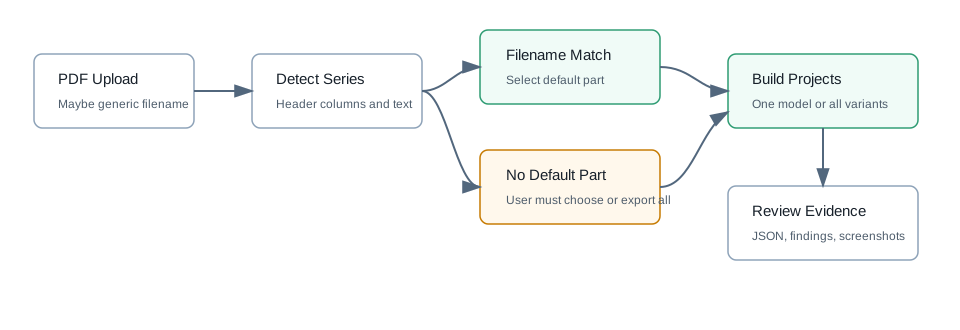
- Upload a PDF datasheet.
- Review the extracted fields, confidence scores, warnings, source snippets, rendered datasheet screenshots, recognized table candidates, and auto-digitized curve data. Click a parameter row to show its matching PDF crop; click the curve digitization table to compare the data against the source plot. If the upload is a multi-part diode series datasheet, choose the target part before generation. When the filename does not contain a detected part number, generation stays disabled until a part is selected.
- Correct common parameters in the review form, or edit the project JSON directly for deeper changes.
- Run parameter fitting and model quality evaluation.
- Select
ABM Behavioral Model,VDMOS Compact Model,Diode Compact Model, orDiode Behavioral Model, and the target SPICE dialect. The workbench can emit common SPICE, LTspice, ngspice, PSpice, HSPICE, Xyce, and experimental QSPICE bundles. See SPICE Dialects. - Generate and download the ZIP model bundle.
Generated files are written under build/webapp/<session>/generated/.
Extraction results are cached under build/webapp/<session>/extract_result.json;
open http://127.0.0.1:8765/?session=<session> to replay a previous review
state for visual regression or continued checking.
The local server also exposes GET /api/capabilities, which reports the active
runtime mode and the shared API contract used by the frontend/backend split.
Extraction Scope
The v1.0 workbench uses PyMuPDF text extraction plus datasheet heuristics. It is good enough to create a reviewable starter model from many tabular MOSFET and diode datasheets, but it is not a full semantic datasheet parser.
The extractor currently targets common fields:
MOSFET:
VDSS, continuousID,VGS_on,VGS_offVGS(th),RDS(on),gfs, internalRGCiss,Coss,CrssQg,Qgs,Qgd- body-diode
VSD,trr,Qrr,Irrm
Diode:
VRRM,IF(AV),IFSMVF, leakageIR- junction capacitance
CjorCt - reverse-recovery
trr,Qrr, andIrrm - package parasitic starter values for anode and cathode leads
Diode series datasheets are handled as a first-class extraction result. The
backend returns the selected project, a series summary, and
variant_projects for each detected part number. The UI can generate either
one selected model or a ZIP bundle containing all variants in separate folders.
If only one capacitance point is found, the workbench creates a conservative
starter C(V) curve so the built-in emitters can run. Replace it with a
digitized curve for serious transient fitting.
Added Analysis Tools
- Table recognition groups PDF words into table candidates and shows the highest-scoring rows in the review pane, with side-by-side PDF image crops.
- Curve digitization detects vector
Ciss/Coss/Crsslog-log plots when the PDF preserves curves as vector paths. - Raster plot digitization renders a calibrated PDF plot crop and traces a single scanned curve with axis/grid suppression, coverage metrics, and a reviewable point list. See Raster Plot Digitization.
- Parameter fitting computes VDMOS starter parameters, MOSFET ABM
recommendations such as
KID,CGD_SCALE, andCGS_SCALE, and diode ABM recovery parameters such asTAU_nsandRR_SCALE. - Model evaluation scores static coverage, dynamic coverage, capacitance consistency, fit consistency, and schema validity. The score is a review aid, not a replacement for waveform validation.